Last Updated: 07 Aug, 2026 | Views: 326
Age: 73
Profession: Politician
Higher Education: St John's College, Oxford (BA)
About (Profile/Biography):
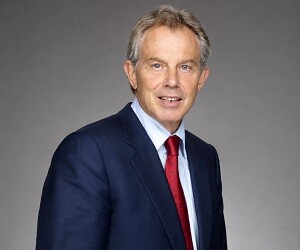
Tony Blair is a British politician and former Labour Prime Minister born on 6 May 1953 in Edinburgh, Scotland. He studied Law at Oxford University and later qualified as a barrister before entering Parliament as MP for Sedgefield in 1983. Tony became Labour leader in 1994 and led the party to a landslide victory in 1997, becoming Prime Minister at the age of 43. He remained in Downing Street until 2007, winning three consecutive general elections. His governments introduced major constitutional, social, and public-service reforms and played a central role in the Northern Ireland peace process. Blair's legacy remains influential but deeply debated because of his decision to join the 2003 Iraq War.
Early Life And Education of Tony Blair
• Tony was born on 6 May 1953 in Edinburgh and spent part of his childhood in Durham, where his father worked as a barrister.
• He studied Law at St John's College, Oxford, where Blair became interested in politics, public speaking, and social change during his student years.
• After Oxford, Tony trained as a barrister and joined the Labour Party in 1975, beginning his long journey into frontline politics.
Early Political Career of Tony Blair
• Blair unsuccessfully contested Beaconsfield in 1982 before winning Sedgefield in 1983, beginning his parliamentary career during Labour's difficult years.
• He quickly rose through Labour's ranks, joining the Shadow Cabinet and becoming Shadow Home Secretary under John Smith in 1992.
• After Smith died suddenly in 1994, Tony won Labour's leadership contest and began reshaping the party around a modern electoral strategy.
Prime Ministerial Career of Tony Blair
• Tony became Prime Minister on 2 May 1997 after Labour won a landslide majority of 179 seats, ending 18 years of Conservative rule.
• His governments introduced Scottish and Welsh devolution, the Human Rights Act, Freedom of Information reforms, and major public-service changes.
• Blair led Labour to further election victories in 2001 and 2005, making him the first Labour leader to win three consecutive elections.
Northern Ireland Peace Process
• Tony played a central role in negotiations that produced the 1998 Good Friday Agreement, helping advance peace after decades of conflict.
• He worked closely with Irish and American leaders while encouraging unionist and nationalist representatives to compromise during difficult negotiations.
• His involvement in Northern Ireland remains one of the most frequently cited achievements of Blair's decade in Downing Street.
Foreign Policy And International Role
• Blair promoted an interventionist foreign policy, supporting military action in Kosovo, Sierra Leone, Afghanistan, and later Iraq during his premiership.
• He developed a particularly close relationship with US President George W. Bush after the September 2001 terrorist attacks in America.
• Tony later served as Quartet Representative for the Middle East, working on diplomatic and economic initiatives involving Israel and Palestine.
Major Controversy Around Tony Blair
• The biggest controversy of Blair's career was his decision to support the 2003 invasion of Iraq alongside the United States and allies.
• The Iraq invasion became deeply divisive after weapons of mass destruction were not found, raising questions about intelligence and decision-making.
• The Chilcot Inquiry later criticised aspects of the process, including inadequate planning and the gap between Britain's ambitions and available resources.
Awards And Recognitions Received by Tony Blair
• Tony received the Presidential Medal of Freedom from US President George W. Bush in 2009 for his international public service.
• He received the 2010 Liberty Medal for his commitment to conflict resolution, particularly his contribution to Northern Ireland's peace process.
• Blair became a Knight Companion of the Order of the Garter in 2022, one of Britain's highest honours for public service.
Later Career And Public Service of Tony Blair
• After leaving office in 2007, Tony founded the Tony Blair Institute, focusing on governance, leadership, and political and economic development.
• He continued international advisory work, particularly with governments seeking reforms in education, technology, health, and economic development.
• Blair also remained an active commentator on British politics, international affairs, terrorism, technology, and the future of democratic government.
Lesser Known Facts About Tony Blair
• Tony played guitar in a rock band called Ugly Rumours while studying at Oxford, showing a creative side rarely associated with his political career.
• He became Britain's youngest Prime Minister since 1812 when he entered Downing Street in 1997 at the age of 43.
• Blair's government introduced civil partnerships in 2004, giving same-sex couples legal recognition and marking a major social reform of his era.
Wait!
Here're some popular profiles for you.